

Language levels
Knowledge of the CEFR levels is useful to understand your starting language skills in order to choose the language courses that best suit your needs, so that you don’t find them too easy or too difficult.
The CEFR (Common European Framework of Reference for Languages) is an international standard for describing language ability, developed by the Council of Europe and used across European Countries but also, increasingly, around the the world.
The CEFR organises language proficiency in six levels (A1-A2-B1-B2-C1-C2), which can be regrouped into three broad levels: Basic User - Independent User - Proficient User.
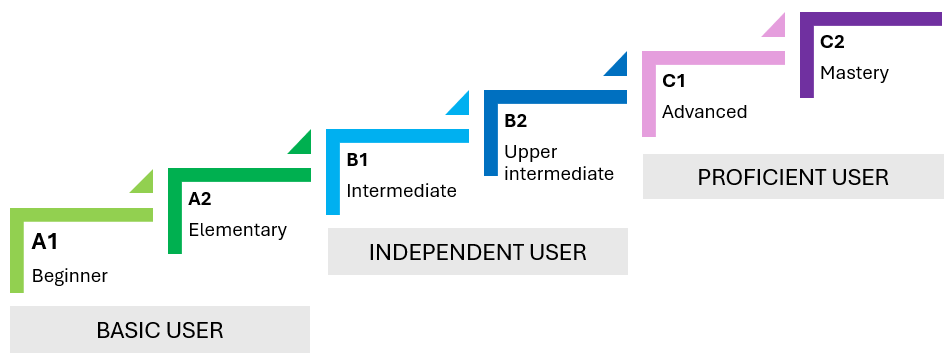
These levels can be further subdivided according to educational needs: e.g. PRE-A1, A2+, B1+…
For each level, the CEFR describes what a learner can do when listening, speaking, reading and writing in a foreign language. A detailed description of the competences corresponding to each of the 6 levels in the various skills can be found in the Europass self-assessment grid, which can help you get an idea of your own language level.
In order to help you choose among the extracurricular courses organized by the Language Centre, online self-assessment/entry tests are made available on the courses Elly pages, which allow you to determine which course is more appropriate for you.